O-Ring Design: How the Main Factors Work Together
An O-ring works as part of an assembly. Cross-section, installed fit, gland dimensions and mating surfaces must be considered with the operating conditions. Material selection cannot compensate for every geometry or assembly problem.
These principles address conventional solid elastomer O-rings. PTFE, encapsulated and other special constructions require their own guidance; compound requirements can also change the approach. Project calculations need defined inputs and assumptions rather than a universal set of groove dimensions.
Start with the Sealing Arrangement
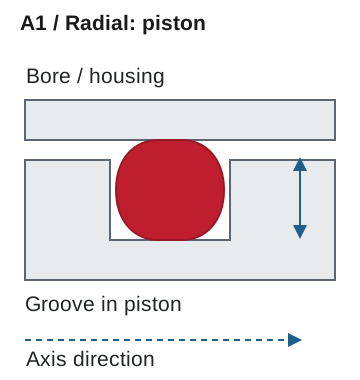
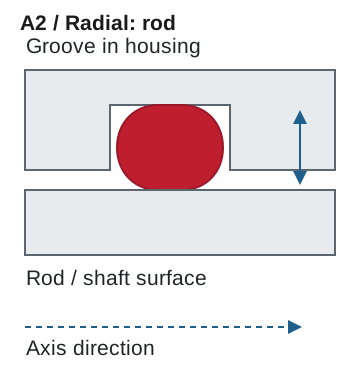
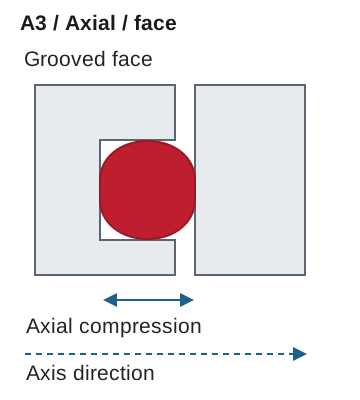
Static and dynamic describe relative movement at the sealing interface. Radial and axial describe the direction of cross-section compression. A radial seal can therefore be static or dynamic.
Radial arrangements require the groove location, mating diameters and clearances for the piston/bore or rod/housing assembly. Axial or face arrangements require the groove and opposing face geometry. Internal or external pressure affects ring diameter selection and the groove wall supporting the ring; flatness, parallelism and joint opening under load affect the sealing space.
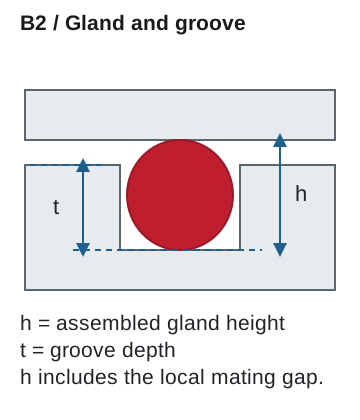
The groove is the recess in a component; the gland is the complete space formed with the opposing component. Groove depth is not always the assembled gland height. Retaining grooves, crush seals and floating pneumatic arrangements need separate treatment.
Squeeze, Installed Stretch and Gland Fill
| Factor | What it describes | Why it matters |
|---|
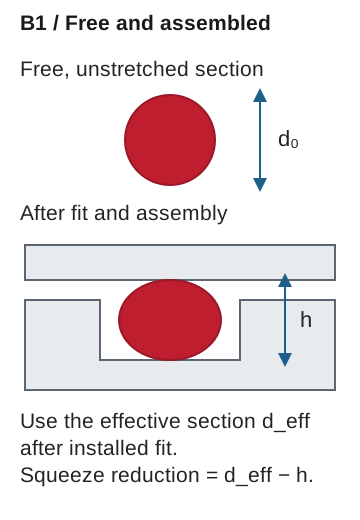
| Squeeze | Reduction in cross-section along the direction of compression | Creates initial contact; excessive squeeze increases assembly load and can increase dynamic friction and wear |
| Installed stretch | Increase in inside diameter from the free, unstretched state to the seated condition, expressed relative to the free-state inside diameter | Can reduce the effective cross-section and change squeeze |
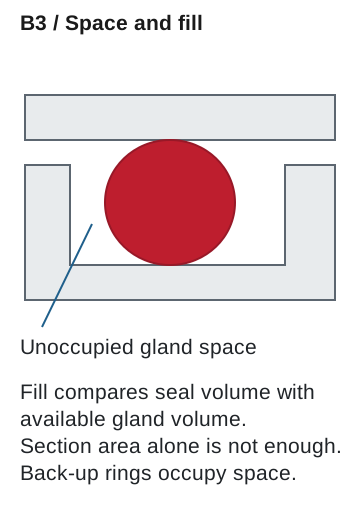
| Gland fill | Seal volume as a proportion of available gland volume | Indicates space remaining for dimensional variation and volume change |
The free-state inside diameter is measured on an uninstalled, unstretched ring under defined measurement conditions. It is not the shaft, rod or groove diameter. For a ring seated in tension, installed stretch compares its seated inside diameter with its free-state inside diameter. Temporary stretching to pass over a component during assembly is a separate check. Piston, rod and face seals have different fit requirements; outside-diameter interference must not be treated as the same condition as inside-diameter stretch.
Squeeze is deformation, not compression force. Force also depends on compound, hardness and ring dimensions. Compression set describes residual deformation after release under specified test conditions; it is not a direct measure of squeeze or service life.
Gland fill and squeeze need separate checks. Widening a groove does not establish squeeze, and adding back-up rings changes the available space. Allowance for thermal expansion and media-induced swelling must be considered with dimensional limits.
Check Tolerance Extremes, Not Only Nominal Dimensions
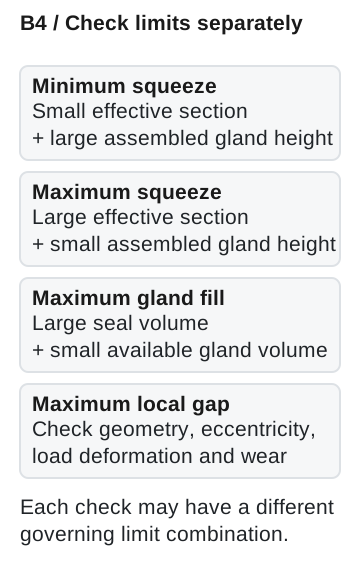
A nominal fit can conceal insufficient squeeze at one combination of limits and excessive compression at another. The calculation needs seal tolerances, effective cross-section after installed stretch and the mating-component dimensions defining the assembled gland.
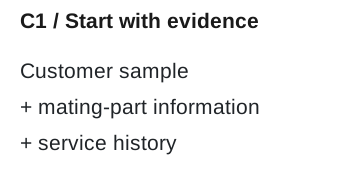
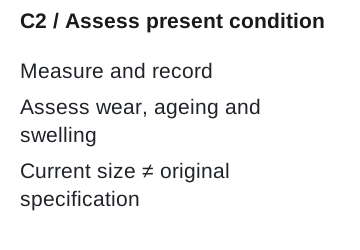
Check minimum squeeze/contact, maximum compression, maximum gland fill and maximum local extrusion clearance separately. Different combinations of tolerance limits may govern each result. Alignment, joint closure and deformation under load can also change the effective geometry. A sample measurement is evidence of its present condition, not proof of the original tolerance limits.
Pressure, Extrusion Clearance and Back-up Rings
Pressure loads the ring against sealing surfaces but also drives elastomer toward a lower-pressure clearance, where extrusion and cycling damage may occur. Assess differential pressure, peaks, direction and reversals together with compound, hardness, cross-section and temperature.
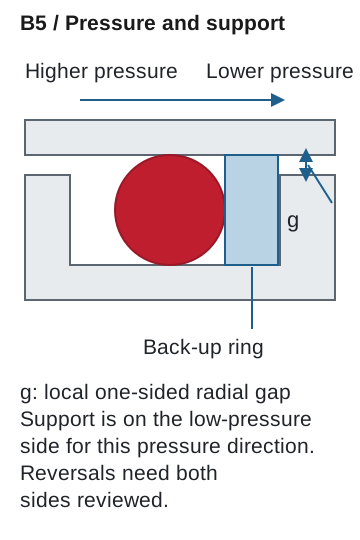
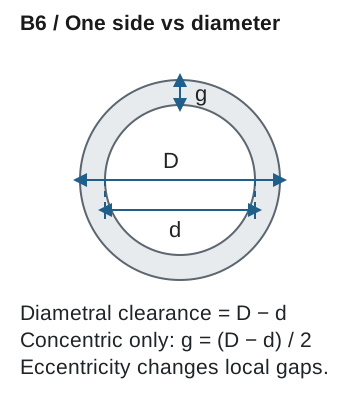
Distinguish a one-sided radial gap from the difference between mating diameters. Eccentricity, side loading, expansion and wear can increase the largest local opening; nominal concentric clearance alone may be misleading.
A back-up ring supports the elastomer at the extrusion gap and is not normally the primary seal. One-direction pressure calls for support on the lower-pressure side; reversing pressure requires consideration of both sides. Construction, material, installation access and additional groove width must suit the assembly. Adding support or hardness alone does not establish a pressure rating.
Motion, Friction and Lubrication
For reciprocating motion, provide stroke, speed, frequency, reversals, dwell periods and lubrication conditions. Breakaway and running friction differ. Uneven friction, misalignment and ring instability can contribute to twisting or spiral damage. Movement across ports also needs review.
Rotation and oscillation require separate assessment. Continuous rotation can generate local frictional heat. An elastomer O-ring stretched around a shaft can contract as it heats, increasing shaft contact pressure and friction and potentially accelerating heat build-up and wear. Do not transfer a reciprocating fit rule to a rotating shaft. Shaft speed, runout, lubrication and heat dissipation need review; an O-ring may not be the appropriate seal type.
Lubrication must suit the compound, media, mating components and application. Assembly lubricant alone does not establish adequate service lubrication.
Media, Temperature and Changes in Volume
Fluid exposure can cause swelling, shrinkage, softening or hardening, affecting contact, friction, extrusion resistance and gland space. Identify the actual fluid or gas, concentrations, mixtures, additives, cleaners, exposure time and temperature. Compatibility guidance screens candidates; it does not confirm every compound and application.
Elastomer and housing expansion can differ, changing squeeze, clearance and fill. Cold conditions affect elastic recovery; heat can alter stiffness and accelerate permanent changes. Friction can raise interface temperature above fluid temperature. Include minimum and maximum temperatures, continuous and short-term exposure, cold starts and thermal cycling. A material temperature range is not the operating range of the complete assembly.
Surface Quality and Assembly Access
Roughness alone does not describe scratches, machining direction, waviness or local defects. Dynamic surfaces and groove walls have different roles; a finer finish is not automatically better where lubrication retention matters. Identify the surface, measurement parameter and units on the drawing. Housing finish and seal surface acceptance are separate requirements.
Review lead-ins, radii, burrs, threads, keyways, ports and the installation path, together with cleanliness, compatible lubrication and fitting aids. A ring that fits when seated may still be damaged during assembly. Solid back-up rings also need installation access.